I don't read that as laziness. In Internal Family Systems terms, it's usually a protective part on duty, the same kind that sits under a lot of self-sabotaging patterns. It wants to be sure before anyone gets in. That's reasonable, so let's give it something solid to stand on.
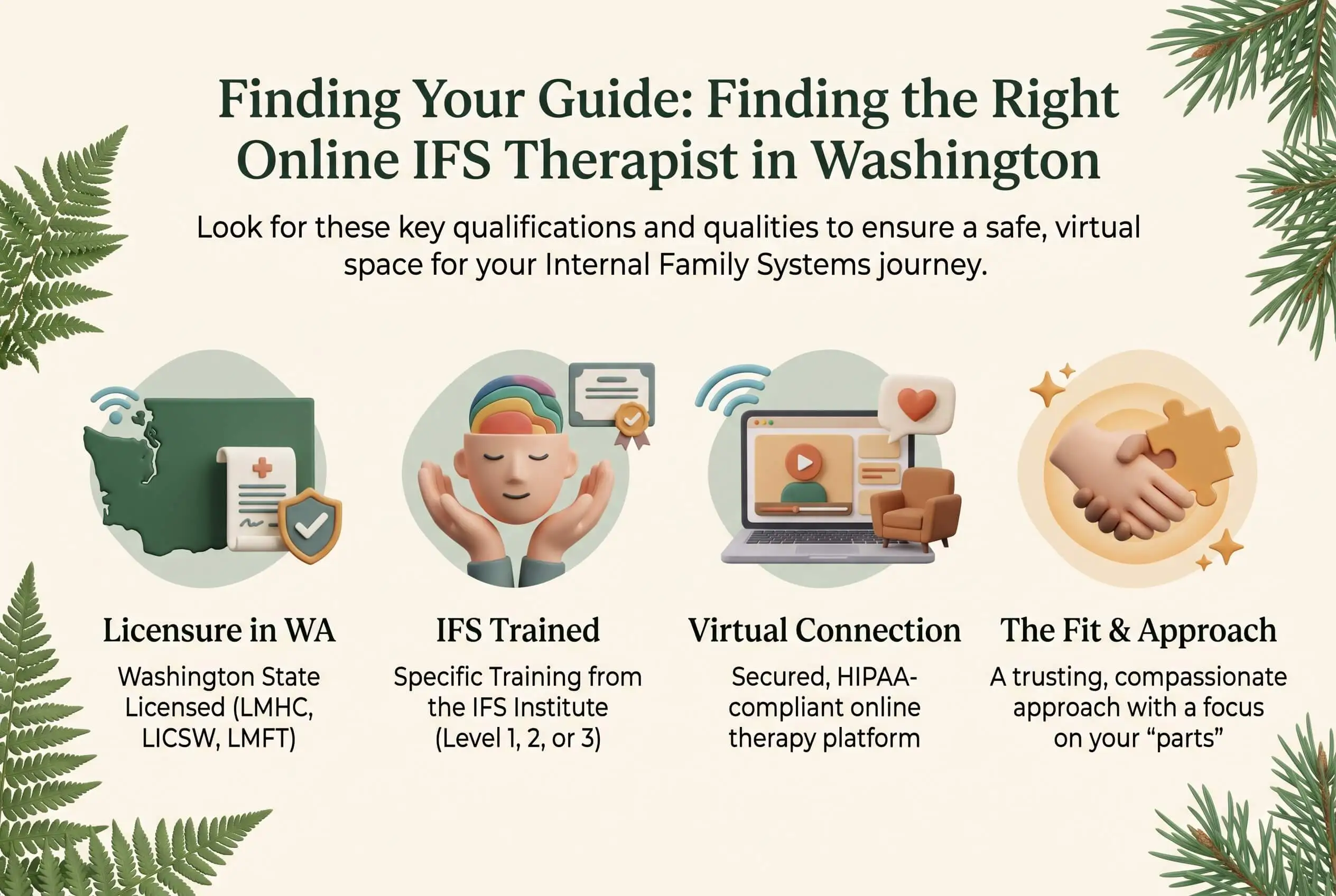
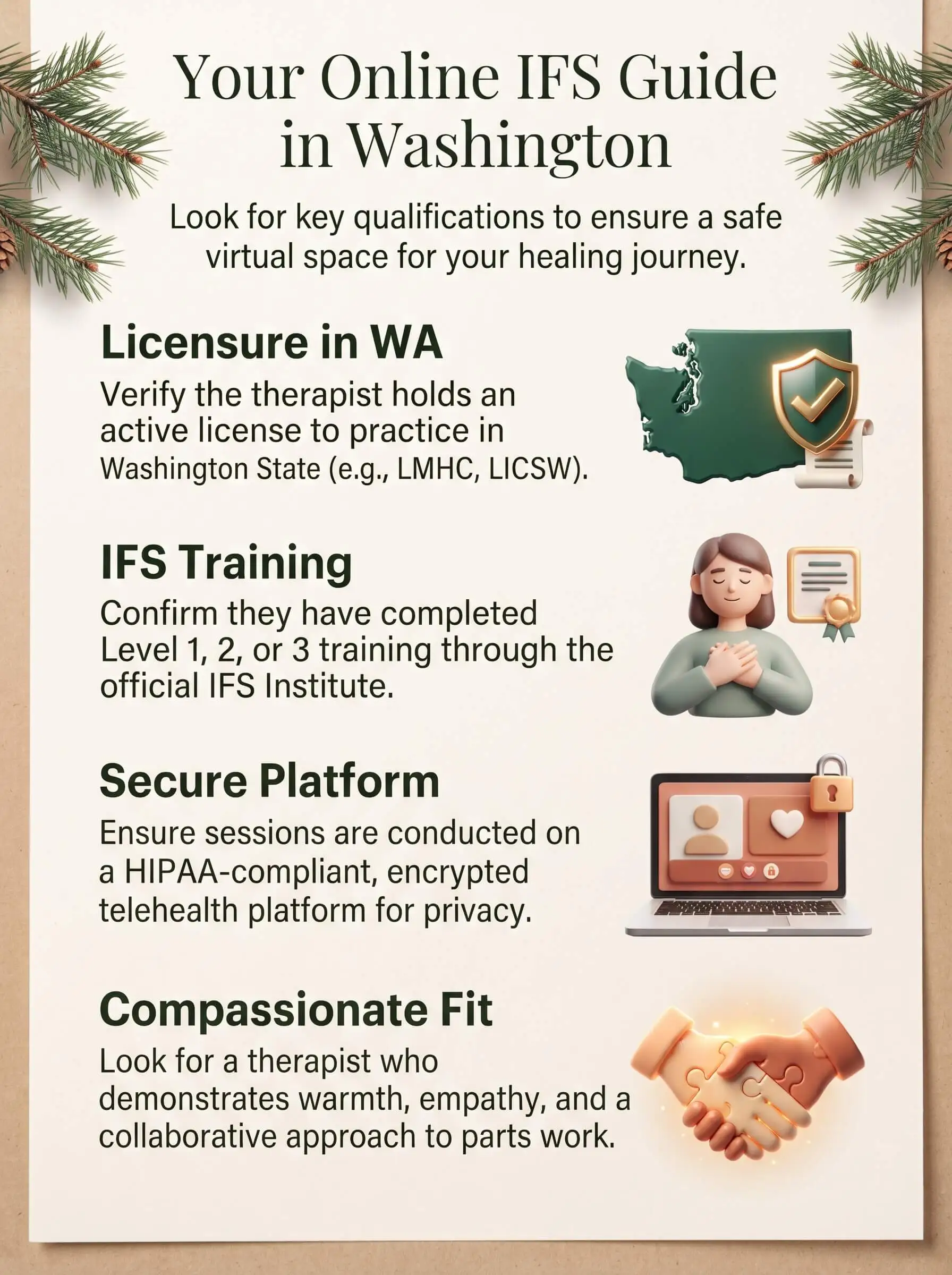
When you're weighing online IFS therapy in Washington, you're looking for four things: a license that covers you while you're in Washington State, at least Level 1 training from the IFS Institute, telehealth logistics the practice actually spells out, and a first conversation where your guarded parts loosen a little.
The first two take about ten minutes to check. The other two take a phone call.
TL;DR Quick Answers
Online IFS Therapy in Washington · Telehealth
Online IFS therapy in Washington is Internal Family Systems therapy over secure video, open to adults anywhere in the state as long as you're physically in Washington during each session. The right therapist matters more than the screen, so check these before you book:
License: Active in Washington. Confirm it in the Department of Health's Provider Credential Search.
IFS training: Level 1 at minimum from the IFS Institute. Certification is a separate, further credential.
Telehealth setup: A secure platform, a plan for dropped connections, and camera-off allowed on hard days.
Your side: A device with a camera, a door that closes, and headphones if you share a home.
Fit: Use the free consultation and notice whether your guarded parts ease up. That reaction tells you more than any badge.
Top Takeaways
License first. Your therapist has to be able to practice in Washington, and the state search confirms it in about a minute.
Level 1 is the floor. The IFS Institute treats it as the minimum for clinical IFS, and certification comes later as a separate step.
Where you sit matters. You need to be physically in Washington for each telehealth session.
Use the free consultation. Bring your questions and pay attention to how your guarded parts respond.
Distance isn't the filter anymore. Online IFS therapy reaches you anywhere in the state, from Bellingham to Walla Walla.
What Online IFS Therapy In Washington Actually Involves
IFS is a kind of therapy built on one idea. Your mind holds many parts, and each one is trying to help, including the ones that make your life harder. Richard Schwartz developed the model in the 1980s. Beneath the parts sits what IFS calls Self, the calm, curious center you already have.
Over video, the work barely changes. You meet on a secure platform, usually for about 50 minutes, somewhere you won't be overheard. If you're curious how the hour itself moves, here's what an IFS session looks like, step by step.
What changes is reach. The right therapist doesn't have to live within driving distance anymore.
Start With The License, Not The Logo
Counseling law looks at where you're sitting during the session, not where your therapist is. So if you're in Washington, your therapist has to be authorized to practice in Washington.
Usually that means one of these Washington licenses:
LMHC (Licensed Mental Health Counselor)
LICSW (Licensed Independent Clinical Social Worker)
LMFT (Licensed Marriage and Family Therapist)
Licensed psychologist, with a PhD or PsyD
Washington has also joined the interstate Counseling Compact, which is meant to let counselors licensed in other member states see Washington clients over telehealth. As of late 2026, the state is still putting it into practice. If someone licensed elsewhere offers to see you, ask them plainly how they're authorized here.
Checking takes about a minute. Type the therapist's name into the Department of Health's credential search, and you'll see the license type, whether it's active, and any discipline on record. I'd run it for every name on your list, including the ones you already like.
Understand IFS Training Levels And Certification
Most people get lost here, and it matters more than any badge on a website.
The IFS Institute, which Richard Schwartz founded, runs three levels of training and considers Level 1 the minimum for practicing IFS clinically. Certification is its own process, with requirements that go beyond the training.
IFS-informed: Has taken IFS Institute courses or been to its conference, without completing Level 1.
IFS Level 1 trained: Finished the foundational training. This is the floor for clinical IFS.
IFS Level 2 or 3 trained: Went further, into specific applications and deeper skills.
IFS Certified Therapist: A licensed clinician who also met the Institute's separate certification requirements.
IFS Certified Practitioner: Certified in IFS, though not necessarily a licensed clinician.
Approved IFS Clinical Consultant: A Certified Therapist the Institute has approved to consult with other clinicians.
A Level 1 therapist with years of IFS behind them can be a wonderful fit. Be wary of anyone offering "parts work" with no IFS training at all. You can confirm a therapist's training level in the IFS Institute's directory.
Look For Experience That Matches What You're Carrying
Ask for two numbers: years licensed, and years doing IFS. They're rarely the same.
Then ask who they see most. Some IFS therapists center their work on trauma. Others spend most of their week with anxiety, perfectionism, or shame, or with whatever a hard childhood left behind. If worry runs your days, read about the link between anxiety and self-sabotage before the call. It'll help you describe your pattern in your own words.
Listen for who they don't see, too. A therapist who tells you that up front is being honest with you, and honesty this early counts for something.
Check The Telehealth Setup Before You Commit
The logistics are small, and they're still worth asking about. A clear practice will tell you:
which secure video platform they use, and whether you need to download anything
what happens if the connection drops halfway through
whether camera-off is fine on hard days
that you need to be physically in Washington for every session, travel included
On your end, you need a device with a camera and somewhere with a door that closes. Headphones help if you share a home.
Questions To Ask In Your Free Consultation
Most IFS therapists offer a short free call. Use it. These are the questions I'd bring:
What's your license, and is it active in Washington?
Which IFS Institute training levels have you completed?
How long have you been practicing IFS specifically?
What do you do when something in a session feels like too much?
Who isn't a good fit for your practice?
Are you in-network with my plan, or will you give me a Good Faith Estimate?
What does the first month usually look like?
While they answer, notice what happens inside you. Does some part of you settle, even slightly? That counts as information too.
It helps to see clear answers in the wild. Lauren Rath's page on online IFS therapy in Washington · Telehealth is a good example. She names her Washington license and IFS Institute training up front, explains why you have to be in the state, lists the plans she accepts, and offers a free 15-minute call.
Red Flags Worth Noticing
A license that doesn't show up in the state search
"Parts work" language with no IFS training behind it
Pressure to open up trauma in the first session
A vague answer when you ask where you need to be during sessions
Fees that stay fuzzy until after you've started
Cost And Insurance In Washington
Plenty of Washington IFS therapists are in-network with major plans, and plenty work out of pocket. If you're paying yourself, federal rules give you the right to a written Good Faith Estimate before care starts. Ask for it before the first session, while you can still compare.
"People spend weeks comparing credentials, and I understand why. Then the consult starts, and somewhere in the first ten minutes a guarded part of them decides whether it's safe to speak. I've watched that happen over a laptop more times than I can count. The license is what gets you onto the call. Whether you stay depends on what happens to that part once you're there."
7 Essential Resources
All of these are free, and none takes more than ten minutes to read.
1. Look Up Any Washington License In A Minute
Search by name or credential number, and you'll see whether the license is active and whether the state has ever disciplined that provider. It's the fastest check on this list.
Source: Washington State Department of Health: Provider Credential Search
2. Find Clinicians Trained In IFS
The IFS Institute's directory lists people who've completed its training, along with each person's training level and any certification. You can search by location and training level.
Source: IFS Institute: Find a Professional
3. Learn What Each IFS Credential Actually Means
This is where the Institute defines IFS-informed, IFS-trained, Certified Therapist, and Certified Practitioner. It also says outright that Level 1 is the minimum for practicing IFS clinically.
Source: IFS Institute: Definitions for IFS Credentials
4. Borrow A Ready-Made List Of Questions
The American Psychological Association's guide covers choosing a therapist, what to ask before you book, and what a first session usually feels like. It is called good chemistry critical. I'd agree.
Source: APA: Understanding Psychotherapy and How It Works
5. See What Telehealth Can Offer You
A short federal page on getting behavioral health care by video, from one-on-one therapy to text-based options, with links on privacy and setup.
Source: Telehealth. HHS.gov: Telehealth for Behavioral Health Care
6. Understand Washington's Counseling Compact
If you're weighing a counselor licensed in another state, start here. The Department of Health explains what the interstate compact is meant to allow and lists the rules adopted so far.
Source: Washington State Department of Health: Counseling Compact
7. Keep A Number Close While You Search
The search can take a few weeks. If things get heavy before you've found someone, the 988 Lifeline is free and confidential, and it's open around the clock by call, text, or chat.
Source: 988 Suicide & Crisis Lifeline
If you only open two of these, open the first two. They answer the questions people most often skip.
3 Statistics
These are the numbers I come back to when someone asks whether online IFS is worth the search.
1. Most People Who Could Use Help Aren't Getting It
Generalized anxiety disorder affects 6.8 million American adults, and only 43.2% are receiving treatment.
Distance, cost, waitlists, and the nerve the first email takes all sit inside that gap.
What I notice: telehealth takes distance off the list. Live in Yakima or out on the Olympic Peninsula, and the IFS therapist who fits you can still be your therapist.
Source: Anxiety & Depression Association of America: Facts and Statistics
2. You'll Know Fairly Soon Whether It Fits
In a classic study the American Psychological Association cites, half of psychotherapy patients improved after eight sessions, and 75% had improved by six months.
What I notice: choosing a therapist isn't a lifetime contract. A consult and a handful of sessions usually tell you whether you've found the right person.
Source: APA: Understanding Psychotherapy and How It Works
3. IFS Holds Up Over Video
PARTS was an online IFS-based program for adults with PTSD. Of its 15 participants, 11 came to 12 or more group sessions.
12 of the 13 who answered said they'd recommend it to a friend, and by week 24, 8 of 15 showed a clinically meaningful drop in PTSD symptoms.
What I notice: it was a small pilot with no control group, and the researchers say so. People kept logging in anyway, which tells me the slow pace of IFS survives a screen.
Source: IFS Institute: Online Group-Based IFS Treatment for PTSD (PARTS)
Research shows that many adults with anxiety still lack access to treatment, while online IFS therapy offers a more accessible option by removing distance barriers. Healthcare professionals can help patients explore whether this approach fits their needs, with early psychotherapy outcomes and a small online IFS pilot suggesting potential benefits for mental health support.
Final Thoughts And Opinion
Credentials get someone onto your list. Fit decides whether they stay there.
My view is that a Level 1 trained therapist who slows down and lets your guarded parts set the pace will usually do more for you than a more decorated one who hurries. The license and training protect you. The relationship does the actual work.
People also blame themselves too much for how long the search takes. Three weeks of comparing profiles says less about your character than about a protective part checking for danger, and that part will probably show up in your first session too. A good IFS therapist expects that and gets curious about it instead of pushing past it.
Some patterns I've seen often enough to expect:
The most careful researchers tend to be the people whose slow, cautious approach suits best.
Most people know within minutes of a consultation whether they'll book again, even when they can't say why.
The most useful question, "What happens when it gets to be too much?", is the one people forget to ask.
Being at home doesn't make the connection the way people expect. For some parts, it seems to help.
So check the license and the training. Then give the part of you that's been hesitating a vote. It's been looking out for you this whole time.
Frequently Asked Questions
Q: Does Online IFS Therapy Work As Well As In-Person?
A: For a lot of people, yes. IFS work happens inside you, so the room around you matters less than you'd think. The research on online IFS is early and small, though encouraging. Some people find it easier to turn inward from their own couch.
Q: Does My Therapist Need A Washington License To See Me Online?
A: They need to be authorized to practice in Washington, because counseling counts as happening wherever you are. In most cases that means a Washington license. If someone licensed in another state offers to see you, ask exactly how they're authorized here.
Q: What's The Difference Between IFS-Trained And IFS Certified?
A: IFS-trained usually means the therapist finished at least Level 1 with the IFS Institute. An IFS Certified Therapist is a licensed clinician who went on to meet the Institute's separate certification requirements. Either can be a good fit.
Q: Can I Have A Session While I'm Traveling Outside Washington?
A: Usually not, if your therapist is licensed only in Washington. You need to be physically in the state during the session, so most therapists will just move the appointment.
Q: Does Insurance Cover Telehealth Therapy In Washington?
A: Often, yes. Many Washington therapists are in-network with major plans for telehealth. Call the behavioral health number on your insurance card to confirm your benefits. If you're paying out of pocket, ask for a Good Faith Estimate first.
Q: How Long Does IFS Therapy Take?
A: That depends on what you're bringing. Some people notice a shift within a couple of months. Deeper trauma work takes longer, and a good therapist won't rush it to hit a timeline.
Q: What Should I Ask In A Free Consultation?
A: Ask about their license, their IFS training level, how long they've practiced IFS, and what they do when a session gets too much. Then notice how you feel while they answer. That reaction is part of the answer.
Q: What If I Don't Have A Private Space At Home?
A: A parked car works, and it's more common than you'd guess. So does a closed door with headphones. If you're worried about being overheard, say so at the start, and your therapist can adjust.
Ready To Find Your Online IFS Therapist?
You don't need it all sorted before you reach out. Pick one name, look up the license, and book a short consultation to see how it feels.
If some part of you is already listing reasons to wait, that's all right. It can come along to the call.
If you're in crisis right now, call or text 988, or dial 911.