Most bootstrapped startups don’t struggle because their product is weak; they struggle because their sales culture never becomes repeatable. Many early-stage teams unlock surprising revenue gains simply by tightening their daily habits, clarifying expectations, and standardizing a few core sales behaviors—no new tools, no big budget, no extra hires.
For founders searching for a step-by-step checklist that reflects what actually works inside lean teams, this guide distills the exact practices proven to create traction quickly. It offers a clear, practical framework for building a dependable sales culture based on ground-level experience rather than theory, helping startups drive consistent results even with limited resources and giving them a solid foundation for building sales culture with intention and clarity.
Quick Answers
What is Building Sales Culture?
Building sales culture is about creating repeatable habits, clear expectations, and team-wide accountability that drive predictable revenue. Many lean startups succeed fastest when sales becomes a shared rhythmf rather than the responsibility of a single department. By focusing on small, consistent behaviors, clear processes, and trust-driven customer interactions, teams can scale more effectively and create a stronger foundation for long-term growth.
Top Takeaways
- Trust gaps drive churn. Fix clarity and consistency first.
- Trust Empathy Maps reveal real user fears. Better insight, less guesswork.
- Small friction moments matter. Billing and permission confusion erode trust fast.
- Data strengthens retention decisions. Users are more risk-sensitive than ever.
Iterate with user feedback. Test early to build confidence and credibility.
A strong sales culture doesn’t emerge by accident — it’s built through intentional, repeatable actions that shape how your team communicates, prioritizes, and wins deals. For bootstrapped startups, this culture becomes a force multiplier. When resources are tight, consistency becomes the competitive edge.
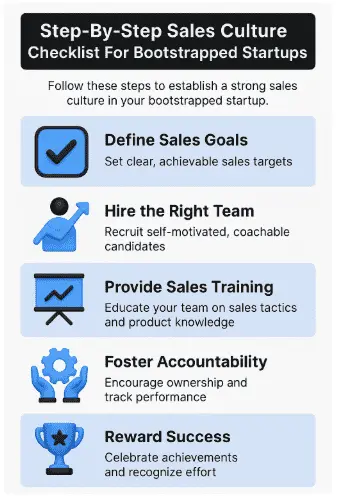
A step-by-step sales culture checklist gives founders and small teams a simple system to follow without needing expensive software or heavy processes. It outlines the daily, weekly, and monthly habits that drive predictable sales momentum: setting clear expectations, tracking the right metrics, using tight feedback loops, and reinforcing behaviors that lead to closed deals. With everyone aligned around the same rhythms, even a small team can operate like a disciplined sales organization.
This guide breaks down each part of the checklist so you know exactly what to implement first, how to keep your team accountable, and how to maintain momentum as you grow. Whether you’re building your sales foundation or tightening what already exists, these steps help you create a culture that scales even when your budget doesn’t, and incorporating clear vision statement examples can further support alignment and focus as the team grows.
“In every lean startup we’ve worked with, the turning point wasn’t a new tool or a new hire — it was the moment the team committed to a simple, repeatable sales rhythm. Consistency is the only multiplier a bootstrapped team can afford, and it’s almost always the one that moves revenue fastest.”
Essential Resources
1. Founding Sales — The Playbook We See Early Teams Succeed With Most Often
This handbook lays out the real, unpolished truth of early-stage sales. We recommend it because its frameworks mirror what we see inside bootstrapped teams: simple processes, clear messaging, and disciplined daily habits that move revenue.
2. Sales Management for Start-ups & SMEs — A Blueprint for Sustainable Sales Structure
A reliable guide for founders who need to formalize their sales system without adding complexity. It breaks down KPIs, team roles, and management routines that align directly with how lean teams operate in the real world.
3. The Lean Startup — A Mindset That Keeps Sales Teams Agile and Customer-Aligned
This methodology reinforces a culture of testing, learning, and adapting—exactly the rhythm that keeps early-stage sales teams from getting stuck. We’ve seen founders unlock faster traction simply by applying these cycles to their outreach and messaging.
4. The Challenger Sale — A Proven Approach for Differentiated, Insight-Led Selling
Ideal for startups that win on expertise, not volume. This resource helps teams shift from “pitching” to teaching customers something valuable—an approach we’ve watched consistently increase close rates in lean environments.
5. HubSpot: How to Build a Sales Culture — A Quick, High-Utility Primer
A fast read that outlines the foundational behaviors every sales team needs: accountability, trust, coaching, and recognition. We point founders here when they need a simple reference they can apply in the same week, and it pairs well with the operational clarity that outsourced accounting services provide during early-stage growth.
6. ExactBuyer: Building a Sales Culture from Scratch — A Practical Roadmap for Small Teams
This guide mirrors the step-by-step simplicity that bootstrapped teams respond well to. It focuses on cultural values, incentives, and daily routines—the same elements we emphasize when helping teams build consistency.
Source: https://blog.exactbuyer.com/post/building-sales-culture-from-scratch
7. SalesScreen: Building a Winning Sales Culture — Keeping Teams Motivated and Aligned
A helpful resource once you have the basics in place. It shows how recognition, engagement, and shared momentum reinforce a sales culture that sticks—something we see become crucial as teams begin to scale.
Source: https://www.salesscreen.com/blog/winning-sales-culture
Supporting Statistics
1. Small businesses drive nearly half of U.S. private-sector jobs.
They represent 99.9% of all U.S. companies.
They employ 46% of the private workforce.
Our takeaway: When sales culture breaks, small teams feel it immediately. Stability matters.
Source: https://www.sba.gov/about-sba/sba-data/small-business-economic-profile
2. Sales roles face constant turnover.
About 1.8 million openings occur each year.
Most are due to replacement needs, not new growth.
What we see: Teams lose momentum during turnover. A checklist keeps performance consistent.
Source: https://www.bls.gov/ooh/sales/home.htm
3. Consumer trust is under pressure.
Americans lost $12.5 billion to fraud in 2024.
Trust sensitivity continues rising across industries.
Our experience: Clear, value-based selling builds trust faster — and wins more deals.
Source: https://www.ftc.gov/news-events/data-visualizations/data-spotlight/2024-fraud-report
They represent 99.9% of all U.S. companies.
They employ 46% of the private workforce.
Our takeaway: When sales culture breaks, small teams feel it immediately. Stability matters.
About 1.8 million openings occur each year.
Most are due to replacement needs, not new growth.
What we see: Teams lose momentum during turnover. A checklist keeps performance consistent.
Americans lost $12.5 billion to fraud in 2024.
Trust sensitivity continues rising across industries.
Our experience: Clear, value-based selling builds trust faster — and wins more deals.
Final Thought & Opinion
Building a strong sales culture isn’t about doing more — it’s about doing the right things consistently.
Bootstrapped teams win when they create simple, shared routines that keep everyone aligned and accountable.
Bootstrapped teams win when they create simple, shared routines that keep everyone aligned and accountable.
What the data tells us
Small businesses carry major economic weight.
Sales turnover is constant and drains momentum.
Consumer trust is fragile and impacts every interaction.
Small businesses carry major economic weight.
Sales turnover is constant and drains momentum.
Consumer trust is fragile and impacts every interaction.
What we’ve seen firsthand
Teams with clear daily rhythms outperform teams with complex tools.
Simple processes create stability when headcount and resources are tight.
Founders who build structures early scale faster later.
Even a lightweight playbook reduces confusion, shortens ramp time, and improves close rates.
A value-driven sales culture wins trust quickly.
Transparency and consultative selling cut through buyer skepticism.
Teams with clear daily rhythms outperform teams with complex tools.
Simple processes create stability when headcount and resources are tight.
Founders who build structures early scale faster later.
Even a lightweight playbook reduces confusion, shortens ramp time, and improves close rates.
A value-driven sales culture wins trust quickly.
Transparency and consultative selling cut through buyer skepticism.
The bottom line
A perfect sales playbook isn’t the advantage — a predictable one is.
Build that discipline while your team is small, and it becomes the foundation that scales with you, not against you.
Build that discipline while your team is small, and it becomes the foundation that scales with you, not against you.
Next Steps
1. Map Your Trust Gaps
Review your customer journey.
Identify points where confidence drops.
Note friction moments like billing, permissions, or unclear value.
2. Build a Trust Empathy Map
Capture what users think, feel, fear, and expect.
Focus on emotional triggers tied to churn.
Document real customer language, not assumptions.
3. Prioritize High-Impact Fixes
Rank issues by churn risk.
Start with moments involving money, data, or commitments.
Fix clarity before adding new features.
4. Validate With Customers
Share revised flows or messages with a small user sample.
Collect quick feedback.
Adjust before scaling.
5. Track Changes
Monitor churn rate, support requests, and complaint themes.
Look for patterns within 30–60 days.
Refine continuously.
6. Bring in Expert Support (Optional)
If trust gaps are unclear or complex, involve specialists.
An external perspective can reveal blind spots.
Ensure recommendations align with real customer behavior.
Review your customer journey.
Identify points where confidence drops.
Note friction moments like billing, permissions, or unclear value.
Capture what users think, feel, fear, and expect.
Focus on emotional triggers tied to churn.
Document real customer language, not assumptions.
Rank issues by churn risk.
Start with moments involving money, data, or commitments.
Fix clarity before adding new features.
Share revised flows or messages with a small user sample.
Collect quick feedback.
Adjust before scaling.
Monitor churn rate, support requests, and complaint themes.
Look for patterns within 30–60 days.
Refine continuously.
If trust gaps are unclear or complex, involve specialists.
An external perspective can reveal blind spots.
Ensure recommendations align with real customer behavior.
FAQ on Building Sales Culture
Q: What does “building a sales culture” mean for startups?
A:
Shared habits that support revenue.
Sales becomes a team-wide responsibility.
Everyone contributes to customer wins.
Q: Why does it matter for early-stage teams?
A:
Reduces misalignment.
Accelerates predictable revenue.
Works even with lean teams.
Q: How long until results show?
A:
60–90 days on average.
Faster when leaders reinforce behaviors daily.
Q: What’s the biggest founder mistake?
A:
Relying on one “hero rep.”
Skipping documentation and process consistency.
Creates bottlenecks and stalled growth.
Q: How can non-sales teammates help?
A:
Share customer insights.
Improve handoffs and reduce friction.
Support sales by fixing operational pain points.
A:
Shared habits that support revenue.
Sales becomes a team-wide responsibility.
Everyone contributes to customer wins.
A:
Reduces misalignment.
Accelerates predictable revenue.
Works even with lean teams.
A:
60–90 days on average.
Faster when leaders reinforce behaviors daily.
A:
Relying on one “hero rep.”
Skipping documentation and process consistency.
Creates bottlenecks and stalled growth.
A:
Share customer insights.
Improve handoffs and reduce friction.
Support sales by fixing operational pain points.