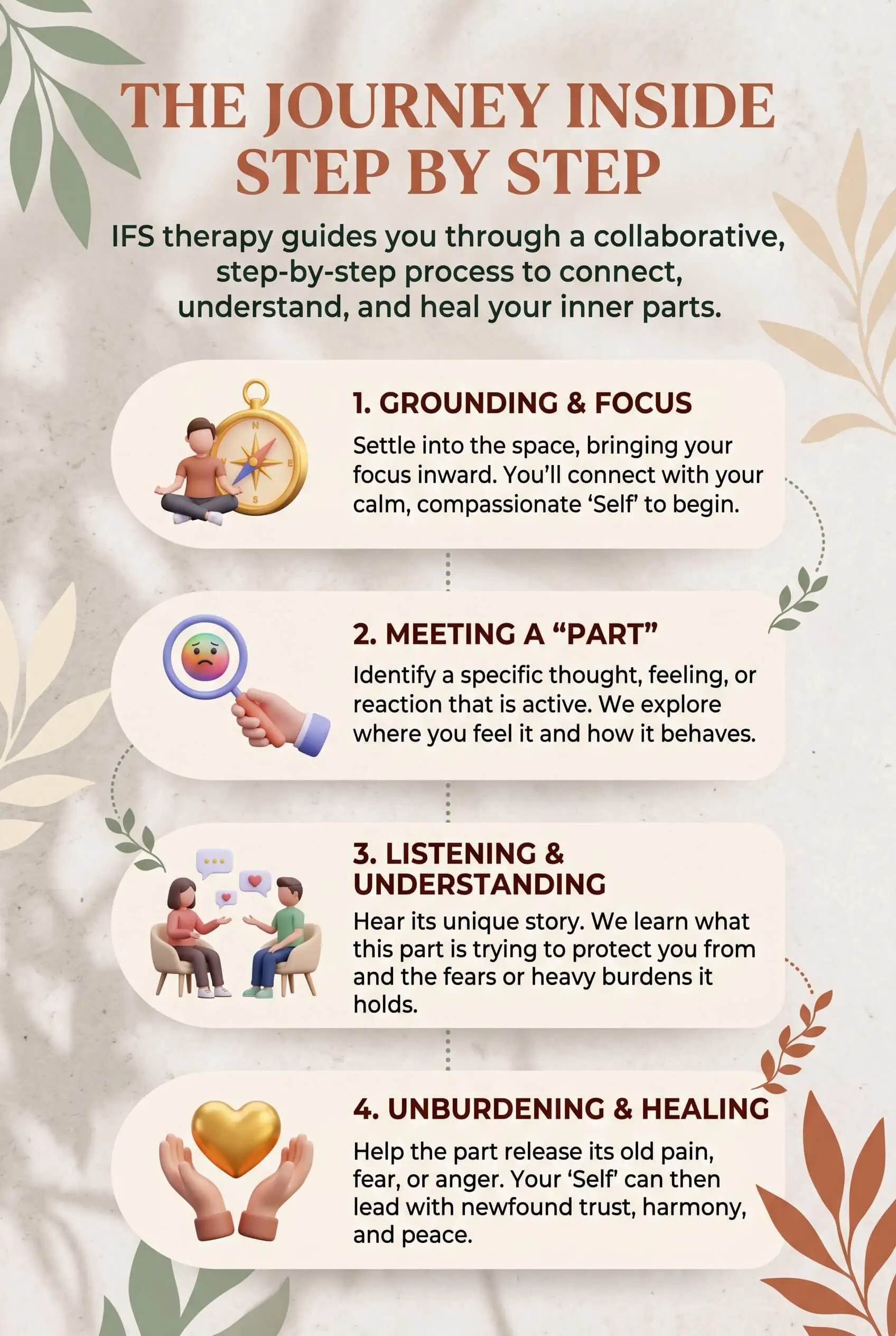
An Internal Family Systems session follows a fairly steady order. You notice what's present, pick one part to focus on, check how you feel toward it, get to know it, and ask what it's afraid of. Deeper sessions can move on to witnessing and unburdening. Each one ends with time to come back to the room.
The first session runs differently. Most of it is conversation.
If you've been circling the same self-sabotaging pattern for years, this may surprise you, because IFS doesn't treat the part running that pattern as an enemy to beat. Here is IFS therapy explained from the client's chair, which is the view most guides skip.
TL;DR Quick Answers
IFS Therapy Explained
IFS, or Internal Family Systems, is a talk therapy that sees your mind as a system of parts, each one trying to protect you, with a calm and curious Self underneath. Rather than trying to get rid of the anxious or self-sabotaging part, you get curious about what it's been guarding.
In short:
Origin. Richard Schwartz developed IFS in the 1980s out of family therapy.
The parts. Managers try to prevent pain, firefighters put it out fast, and exiles carry the old hurt.
Self. A steady center you already have. Therapy makes room for it.
The shift. Parts ease off once they trust that nobody is trying to remove them.
In a session. Notice what's here, pick one part, check how you feel toward it, learn its job and its fears, then close.
Evidence. Early studies for PTSD and depression look promising, and the research base is still small.
Top Takeaways
There's A Rhythm To It. Notice, focus on one part, check how you feel toward it, get to know it, ask what it fears, then close.
Session One Is Mostly Talking. Expect questions about your history and goals, and maybe a brief look inward.
Curiosity Is The Green Light. Once you're curious about a part instead of irritated by it, the real work can start.
Deeper Healing Waits For Permission. Witnessing and unburdening come later, and only when your protective parts agree.
You Can Always Say Not Yet. The pace belongs to you, and a good IFS therapist treats that as part of the method.
IFS Therapy Explained In One Minute
IFS is a kind of talk therapy built on one idea: your mind holds many parts, and every one of them is trying to help, including the ones that make life harder.
Richard Schwartz developed the Internal Family Systems model in the 1980s, out of his work as a family therapist. His clients kept describing their inner lives the way people describe a family. One part kept the peace. Another blew up. One nobody mentioned at all.
IFS sorts parts loosely into three roles:
Managers plan ahead and keep things from going wrong. The inner critic and the perfectionist usually live here.
Firefighters rush in when pain breaks through anyway, with hours of scrolling, an early drink, or a sharp word to someone you love.
Exiles carry old hurt, often from early in life, and the other two work hard to keep them out of sight.
Underneath all of them sits what IFS calls Self, a calm and curious center that's already there. You don't have to build it, only make room for it.
Seen this way, self-sabotage starts to make a strange kind of sense. The part that procrastinates may be a manager guarding you from failure. If you've wondered about the roots of self-sabotage, IFS offers a fairly kind answer: a part learned that job young and is still doing it. Lauren Rath's guide to IFS therapy explained in plain language covers parts and Self in more depth.
Your First IFS Session: What To Expect
Most first sessions are about getting to know each other. The deeper work comes later.
Your therapist will likely ask what brought you in, what you'd like to be different, and a little about your history. You'll talk about pace and consent too, and you can slow down or say not yet whenever you need to. Many IFS therapists explain parts and Self in everyday words early on, so the language doesn't feel odd the first time you use it.
If there's time, you might take a short first look inward. It could be as small as noticing the nervous part that nearly cancelled the appointment. Nobody will ask you to relive anything painful in session one.
Sessions usually run about 50 minutes. Plenty of people do this over video, and some find it easier to turn inward from their own couch.
The IFS Session, Step By Step
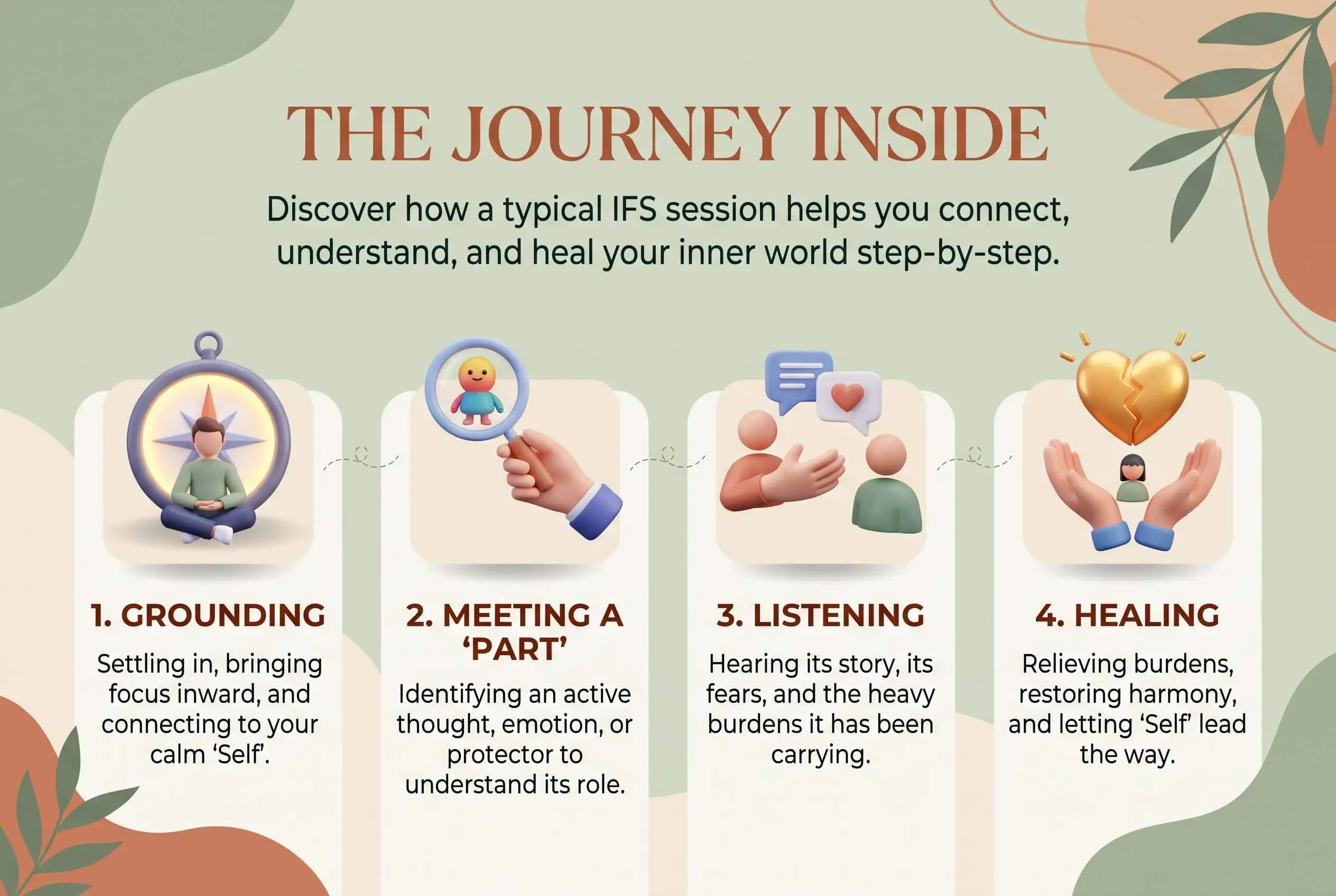
Once the groundwork is in place, sessions settle into a recognizable rhythm. Therapists often learn the early stages as the 6 Fs: find, focus, flesh out, feel toward, befriend, and fears. Here's how each one feels from where you're sitting.
Step 1: Settle In And Notice What's Here
Sessions open with noticing. Your therapist might ask what's going on inside right now, and the answer can be a tight chest, a restless leg, or a familiar critical voice. You don't need to name a part yet.
Step 2: Choose One Part To Focus On
You and your therapist pick one thing to stay with, then flesh it out. Where do you feel it? Does it seem to have an age, an image, a tone of voice? Some people get a clear picture. Others only get a sensation, and that works just as well.
Step 3: Check How You Feel Toward It
This is the heart of IFS. Your therapist asks, "How do you feel about this part?" If the answer is curious, calm, or open, Self is present. Annoyed or afraid usually means another part has stepped in, which IFS calls being blended. Your therapist will ask that part to give you a little room, a process called unblending, until the curiosity comes back.
Step 4: Get To Know The Part
Now you befriend it. What job has it been doing, and for how long? What does it want you to understand? This tends to feel less like analysis and more like finally meeting a coworker who's been covering three shifts without anyone noticing.
Step 5: Ask What It's Afraid Of
Your therapist may ask what the part fears would happen if it stopped. The answers are often old, and they can surprise you. A part that keeps you busy might be afraid of what you'd feel if you sat still. If it's a firefighter, this is where you may start to see why self-destructive behavior keeps coming back.
Step 6: Witnessing And Unburdening, When The System Is Ready
This usually happens in later sessions, and only once your protective parts agree. With their permission, you may meet an exile and witness what it went through. Some exiles want you to bring them out of an old scene first. Then the part can set down what it's been carrying, like shame or a belief that "I'm too much," and take in something lighter in its place.
Step 7: Close The Session And Come Back
Good IFS sessions leave time to land. Your therapist checks in, you might thank the parts that showed up, and your attention returns to the room. You should walk out steady enough to drive home.
How Long Is An IFS Session, And How Many Will You Need?
Expect about 50 minutes per session, though some therapists book 90-minute sessions for deeper work. There's no set number. A few months around one stubborn pattern is common, and some people stay longer because each part they meet leads to another. A therapist can't honestly predict your number on the first phone call, and a good one won't try.
"The question I ask most is also the plainest one: how do you feel toward this part? Early on, people usually tell me they want it gone, and that's fine. It just tells me another part has stepped in. So we slow down and ask that one for a little room. Sometimes ten minutes later, sometimes three sessions later, the answer shifts to 'I'm curious about it.' I've come to trust that shift more than any insight I could hand someone. The part that's been braced for a fight finds out nobody came to fight it."
7 Essential Resources
These are free to read, and I'd trust any of them over a sales page.
1. Start With The People Who Built The Model
The IFS Institute, founded by Richard Schwartz, explains parts, Self, and what it calls the 8 Cs, among them calm, curiosity, and compassion. It's also refreshingly frank that the research base is still small.
Source: IFS Institute: What Is Internal Family Systems?
2. Find Someone Trained In IFS
The Institute's directory lists close to 10,000 people. You can filter by location, training level, certification, and whether they're taking new clients. Read its note on the difference between a Certified IFS Therapist and a Certified IFS Practitioner before you pick.
Source: IFS Institute: IFS Directory
3. Get The Basics Of Talk Therapy
NIMH covers what psychotherapy is and where to find a provider. Its list of questions to ask a new therapist works for any approach, IFS included.
Source: National Institute of Mental Health: Psychotherapies
4. Know What A First Appointment Usually Covers
The American Psychological Association walks through choosing a therapist, what happens in a first session, and how long therapy tends to take. With that baseline in hand, it's easier to spot what IFS does differently.
Source: APA: Understanding Psychotherapy and How It Works
5. Decode The Letters After A Therapist's Name
LPC, LMFT, LCSW, PhD. NAMI explains what each one means and the training behind it.
Source: NAMI: Types of Mental Health Professionals
6. Learn What Safe Care Should Feel Like
SAMHSA sets out the principles of trauma-informed care, including safety, trust, and collaboration. A good IFS session should feel like those principles in practice.
Source: SAMHSA: Trauma-Informed Approaches and Programs
7. Keep A Number Handy Between Sessions
If a session stirs up more than you can hold before the next one, the 988 Lifeline is free, confidential, and open around the clock by call, text, or chat.
Source: 988 Suicide & Crisis Lifeline
These resources provide practical guidance on understanding IFS therapy, finding a qualified health professional, preparing for your first session, and recognising safe, trauma-informed care. They also offer trusted information on therapist credentials, treatment expectations, and crisis support to help individuals make informed decisions about their mental health and emotional well-being.
3 Statistics Worth Knowing
1. An Early IFS Study For PTSD Showed Big Changes
In a pilot study led by Hilary Hodgdon and co-authored by Richard Schwartz, 13 adults with PTSD completed 16 sessions of IFS. By the end, only 1 of them still met the criteria for PTSD.
What I notice: that's 92% of a very small group, with no control group to compare against. I find it encouraging, and the researchers themselves called for a larger randomized trial before anyone draws big conclusions.
Source: IFS Institute: IFS Treatment for PTSD and Comorbid Conditions, A Pilot Study
2. People Keep Showing Up To Online IFS Groups
In a study of PARTS, an online group program built on IFS for people with PTSD, 11 of 15 participants came to 12 or more sessions.
12 of the 13 people who answered said they'd recommend it to a friend.
What I notice: nobody keeps logging in to something that feels like being pried open. The slow pace seems to travel well over video.
Source: IFS Institute: Online Group-Based IFS Treatment for PTSD
3. Therapy Often Helps Sooner Than People Expect
The American Psychological Association points to a classic study in which half of psychotherapy patients improved after eight sessions.
By six months, 75% had improved.
The APA also notes that some people start feeling better in about 6 to 12 sessions.
A typical session, by its count, lasts 45 to 50 minutes.
What I notice: you don't have to sign up for years to learn whether IFS fits you. A few months usually tells you a lot.
Source: APA: Understanding Psychotherapy and How It Works
Final Thoughts And Opinion
If I could hand you one thing before your first session, it would be permission to get curious about the part you'd most like to fire.
Where I've landed, after looking closely at how this work unfolds:
Slowness does the work. Protective parts have spent years being argued with. A better plan rarely settles them. A stretch of time where nobody asks anything of them usually does.
Self-sabotage reads differently here. The part that cancels plans or starts the fight is usually trying to prevent something it thinks is worse. Once people see that, many of them stop fighting themselves quite so hard.
Go in with honest expectations. The early research is promising, and the IFS Institute says openly that the evidence base is still small. You deserve to know that before you book.
If the language of parts never clicks, that's worth knowing. Another approach may suit you better, and finding that out counts as progress.
People usually come in wanting a part gone. More often, the part stays and simply eases off, and that turns out to be what they were after all along.
Frequently Asked Questions
Q: What Happens In The First IFS Therapy Session?
A: Mostly conversation. Your therapist asks what brought you in, what you'd like to change, and a bit about your history, and the two of you agree on a pace. If time allows, you might spend a few minutes with one part, often the nervous one that almost skipped the appointment.
Q: Is IFS Therapy Evidence-Based?
A: Partly. Pilot studies for PTSD and depression look promising, and the IFS Institute says plainly that the evidence base is still small. I'd call it a promising approach with the research still catching up.
Q: What If I Can't Find Or Feel A Part?
A: Feeling nothing is often information. A part may have decided years ago that looking inside wasn't a good idea, and your therapist will usually get to know that one first.
Q: Do I Have To Talk About Trauma?
A: No. You never have to share details you'd rather keep. Painful memories only come up later, with your protective parts' permission, and plenty of people in IFS wouldn't call their history trauma at all.
Q: How Is IFS Different From CBT?
A: CBT mostly works with thoughts and behaviors, testing unhelpful patterns and practicing new ones. IFS asks who inside you holds the thought and what it's protecting. Both help people. They just point your attention in different directions.
Q: Will I Get Overwhelmed?
A: A trained IFS therapist works hard to keep that from happening. If a feeling starts to flood you, they'll slow down and ask it for some space before going any further.
Q: Can IFS Therapy Be Done Online?
A: Yes. Many IFS therapists work over video, and in one study of an online IFS group program, most participants kept coming back. Some people find it easier to turn inward from home.
Ready To Meet Your Parts?
If one part of you has run the same pattern for years, it may be ready to be listened to. Access to compassionate mental health care reflects the importance of health and wellness as fundamental human rights. Look for an IFS-trained therapist and book a short consultation. Many offer one free, and you only need to describe what's been going on in your own words.
The nervous part is welcome to come along.